Also do not forget that the next rain event will probably be a scab event as we have not had a good event in North Jersey yet.
by Mike Fargione, Cornell with Win Cowgill, Rutgers/NJAES

Showing posts with label Tree Fruit. Show all posts
Showing posts with label Tree Fruit. Show all posts
Spray Cherry Trees for Bacterial Canker
Win Cowgill, Professor and Area Fruit Agent
Bacterial Canker continues to be a serious bacterial disease of both sweet and tart cherry in New Jersey as well as all other regions where the climate is humid. Bacterial canker or bacterial gummosis of sweet cherry is caused by several Pseudomonas bacterium.
This disease infects flower buds and spurs.
Bacterial Canker continues to be a serious bacterial disease of both sweet and tart cherry in New Jersey as well as all other regions where the climate is humid. Bacterial canker or bacterial gummosis of sweet cherry is caused by several Pseudomonas bacterium.
This disease infects flower buds and spurs.

Are You Using our NEWA Website for Apple Scab Forecasting?
Win Cowgill
Professor and Area Fruit Agent
Are you using our new Cornell NEWA http://newa.cornell.edu/ scab prediction system? Rutgers Cooperative Extension has been a partner with Cornell for the past two years to bring this weather system with disease forecasting to you. NEWA Apple Disease Models
Note: Adequate hours of wetting have occurred for apple scab infections to occur.
Professor and Area Fruit Agent
Are you using our new Cornell NEWA http://newa.cornell.edu/ scab prediction system? Rutgers Cooperative Extension has been a partner with Cornell for the past two years to bring this weather system with disease forecasting to you. NEWA Apple Disease Models
Note: Adequate hours of wetting have occurred for apple scab infections to occur.
Highlights from IFTA
This week our friend Jon Clements, Extension Educator UMass-Amherst, reports on the 56th Annual IFTA Conference held February 23 - March 2 in Boston. His insights on the workshops and tours make for a good read.
Jon writes...
First, on Saturday, February 23 were two Pre-Conference Intensive Workshops. Altogether, there were about 200 attendees split between "Strategies for Improving Production Practices" and "Managing Pick Your Own Tree Fruit Operations."
...in the "Strategies" session Equilifruit disks were passed out and explained how to use by James Schupp of Penn State, and I won't forget Tom Chudleigh's comment in the "Managing" Workshop: "It's easier to increase revenue $10,000 than decrease expenses $1,000!"
Read more...
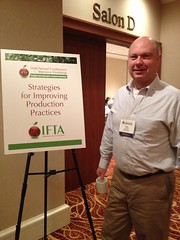 | |
| Win Cowgil @ IFTA |
Jon writes...
First, on Saturday, February 23 were two Pre-Conference Intensive Workshops. Altogether, there were about 200 attendees split between "Strategies for Improving Production Practices" and "Managing Pick Your Own Tree Fruit Operations."
...in the "Strategies" session Equilifruit disks were passed out and explained how to use by James Schupp of Penn State, and I won't forget Tom Chudleigh's comment in the "Managing" Workshop: "It's easier to increase revenue $10,000 than decrease expenses $1,000!"
Read more...
North Jersey Commercial Fruit Growers Meeting
-Win Cowgill
The North Jersey Commercial Fruit Growers Meeting will be held Tuesday, March 5, 2013 at the Rutgers Snyder Research and Extension Farm (Hunterdon County) 8:30 a.m. - 4:30 p.m.
Address: 140 Locust Grove Road, Pittstown, NJ 08867
Contact Diana Boesch at 908-788-1339 to reserve you spot and lunch.
Pre registration required for program and luncheon, Deadline Friday, March 1, 2013.
The North Jersey Commercial Fruit Growers Meeting will be held Tuesday, March 5, 2013 at the Rutgers Snyder Research and Extension Farm (Hunterdon County) 8:30 a.m. - 4:30 p.m.
Address: 140 Locust Grove Road, Pittstown, NJ 08867
Contact Diana Boesch at 908-788-1339 to reserve you spot and lunch.
Pre registration required for program and luncheon, Deadline Friday, March 1, 2013.
North Jersey Tree Fruit Meeting
Hold the Date March 5, 2013
Location: Rutgers Snyder Farm
140 Locust Grove Road, Pittstown, NJ 08867
Time- 8:30- 4:00
Program to follow
Location: Rutgers Snyder Farm
140 Locust Grove Road, Pittstown, NJ 08867
Time- 8:30- 4:00
Program to follow
This Week’s Weather and Orchard Pruning
Michael J. Fargione
Extension Educator, Cornell Cooperative Extension of Ulster County-
Reprinted from the Cornell Tree Fruit Grower Alert Message of 1/28/13
With Edits from Win Cowgill for NJ
The significant cold of the last week should have helped trees develop some additional cold-hardiness in NY and Northern New Jersey. However, daytime temperatures are expected to reach the upper 40’s on Tuesday and close to 60F on Wednesday. This begins to deharden the trees.
Unfortunately, we will then drop back to very cold weather with low temperatures in the low 20’s on Thursday and in the teens on Friday through the weekend. Given these predictions, trees pruned on Tuesday-Thursday might be more susceptible to cold injury. You might want to suspend pruning Tuesday-Thursday, particularly in younger and/or more valuable blocks. Prune only the older mature apples.
We are forecast for heavy rain on Wednesday, which could make pruning quite unpleasant anyway.
Growers should be at our Tri State Fruit meeting in Hershey, PA this week anyway :-)
Its not too late to come out to the largest trade show on the east coast if even for the day.
Extension Educator, Cornell Cooperative Extension of Ulster County-
Reprinted from the Cornell Tree Fruit Grower Alert Message of 1/28/13
With Edits from Win Cowgill for NJ
The significant cold of the last week should have helped trees develop some additional cold-hardiness in NY and Northern New Jersey. However, daytime temperatures are expected to reach the upper 40’s on Tuesday and close to 60F on Wednesday. This begins to deharden the trees.
Unfortunately, we will then drop back to very cold weather with low temperatures in the low 20’s on Thursday and in the teens on Friday through the weekend. Given these predictions, trees pruned on Tuesday-Thursday might be more susceptible to cold injury. You might want to suspend pruning Tuesday-Thursday, particularly in younger and/or more valuable blocks. Prune only the older mature apples.
We are forecast for heavy rain on Wednesday, which could make pruning quite unpleasant anyway.
Growers should be at our Tri State Fruit meeting in Hershey, PA this week anyway :-)
Its not too late to come out to the largest trade show on the east coast if even for the day.
Pruning Vertical Axis 2013
Steve A. Hoying, Cornell Hudson Valley Lab (written1-10-13)
With the consistently colder weather we can now start on established plantings and more sensitive varieties.
With the consistently colder weather we can now start on established plantings and more sensitive varieties.
Appletesters.net Assists Growers in Variety Selection
-Win Cowgill, New Jersey Agricultural Experiment Station & Jon Clements, UMass – Amherst
Appletesters.net is a new website designed to assist apple growers in variety and cultivar selection for new orchard plantings. It is also designed to provide a location for anyone conducting cooperative apple evaluation and testing to report and archive their findings using a unified protocol for apple variety fruit and trees.
Appletesters.net is a new website designed to assist apple growers in variety and cultivar selection for new orchard plantings. It is also designed to provide a location for anyone conducting cooperative apple evaluation and testing to report and archive their findings using a unified protocol for apple variety fruit and trees.
This Week in the Plant & Pest Advisory: 12-11-2012
Plant & Pest Advisory - Fruit Edition (printable pdf)
- African Fig Fly
- Cultural Control of Apple Scab
- Mid Atlantic Fruit and Vegetable Convention and Trade Show: Rutgers Faculty Speakers; Wine Grape Program; Fresh Apple Cider Contest
Cultural Control of Apple Scab
-Win Cowgill
For growers that have had trouble with apple scab there are two things that you can do now to prevent disease pressure next spring: mowing and spraying urea on the ground on the falling leaves.
Two fact sheets outline the details and are worth review:
Reducing Apple Scab Risks and Saving Scab Sprays (UMass)
Reduction of overwintering inoculum in orchards with apple scab (MSU)
For growers that have had trouble with apple scab there are two things that you can do now to prevent disease pressure next spring: mowing and spraying urea on the ground on the falling leaves.
Two fact sheets outline the details and are worth review:
Reducing Apple Scab Risks and Saving Scab Sprays (UMass)
Reduction of overwintering inoculum in orchards with apple scab (MSU)
NJ Fruit Crop Insurance Deadline: November 20
-Win Cowgill and David L. Lee
All fruit growers should note that November 20, 2012 Is the Deadline
for Fruit Crop Insurance in New Jersey
Important Dates
All fruit growers should note that November 20, 2012 Is the Deadline
for Fruit Crop Insurance in New Jersey
Important Dates
- Sales Closing Tree Fruit, Blueberries and NAP - November 20, 2012 for 2013 crop
- Production Report Due for 2012 - January 13, 2013
- Acreage Report Due for 2012 - January 15, 2013
- New Jersey producers who grow apples, peaches, blueberries, and cranberries who are interested in crop insurance must contact a crop insurance agent well before November 20, 2012.
Year of The Stink Bug?
Jon Clements, Extension Educator, UMASS
Reprinted from Healthy Fruit, Volume 20, Number 19. September 18, 2012
https://list.umass.edu/mailman/listinfo/healthyfruit
Editors Note: I have been seeing a large number of the native brown stink bug on ripening apples feeding on Asian pears at the Rutgers Snyder farm, as confirmed yesterday by our fruit IPM Program Associate, Dr. Atanas Atanassov
I have observed an incredible number of stink bugs in recently unsprayed peach orchards and to a lesser extent in apples. These are green and brown stink bugs, not the feared brown marmorated stink bug, BMSB (yet). But these stink bugs feed on fruit too and can cause economic damage if left unchecked.
Quoting from Michael Fargione’s e-mail news out of the Hudson Valley: “Stink bugs (particularly green stink bug and brown marmorated stink bug) are now causing significant economic damage to apples and pears in some blocks in our region. Growers should examine harvested fruit in the bins and scout unharvested blocks, particularly in Orange and Ulster Counties. Rapid treatment with an effective material like Danitol (10 2/3 to 21 1/3 oz per acre, 14 day PHI) or another effective, labeled pyrethroid or pyrethroid pre-mix is warranted if scouting shows the presence of stink bugs or fruit damage (bugs can be harder to find) and sufficient PHI exists.
Entomologist Peter Jentsch has speculated that evening treatments may be more effective as these insects tend to be more active migrating and feeding at night.” I have found the new website: http://stopbmsb.org to be especially Useful for BMSB information, you should check it out.
Editors Note: it appears our BMSB populations are down for some reason. As the BMSB starts to cluster for the fall our observations and injury usually go up. Growers should be vigilant on late ripening blocks.
Editor Win Cowgill, Professor and Area Fruit Agent
Reprinted from Healthy Fruit, Volume 20, Number 19. September 18, 2012
https://list.umass.edu/mailman/listinfo/healthyfruit
Editors Note: I have been seeing a large number of the native brown stink bug on ripening apples feeding on Asian pears at the Rutgers Snyder farm, as confirmed yesterday by our fruit IPM Program Associate, Dr. Atanas Atanassov
I have observed an incredible number of stink bugs in recently unsprayed peach orchards and to a lesser extent in apples. These are green and brown stink bugs, not the feared brown marmorated stink bug, BMSB (yet). But these stink bugs feed on fruit too and can cause economic damage if left unchecked.
Quoting from Michael Fargione’s e-mail news out of the Hudson Valley: “Stink bugs (particularly green stink bug and brown marmorated stink bug) are now causing significant economic damage to apples and pears in some blocks in our region. Growers should examine harvested fruit in the bins and scout unharvested blocks, particularly in Orange and Ulster Counties. Rapid treatment with an effective material like Danitol (10 2/3 to 21 1/3 oz per acre, 14 day PHI) or another effective, labeled pyrethroid or pyrethroid pre-mix is warranted if scouting shows the presence of stink bugs or fruit damage (bugs can be harder to find) and sufficient PHI exists.
Entomologist Peter Jentsch has speculated that evening treatments may be more effective as these insects tend to be more active migrating and feeding at night.” I have found the new website: http://stopbmsb.org to be especially Useful for BMSB information, you should check it out.
Editors Note: it appears our BMSB populations are down for some reason. As the BMSB starts to cluster for the fall our observations and injury usually go up. Growers should be vigilant on late ripening blocks.
Editor Win Cowgill, Professor and Area Fruit Agent
Apple Maturity Update 9/11 for North-Central New Jersey
-Win Cowgill, Suzanne Solner- Figler, Rebecca Magron
Later varieties have colored this last week and sugars remain high across the board for varieties and location as measured by BRIX. In all the blocks I visited the last Fruit continues to mature days early for most cultivars. Cool night temperatures in the 40’s last night with sunny days have triggered good color development. Sunny days and cool nights in the fifties forecast all week should bring on great color.
Later varieties have colored this last week and sugars remain high across the board for varieties and location as measured by BRIX. In all the blocks I visited the last Fruit continues to mature days early for most cultivars. Cool night temperatures in the 40’s last night with sunny days have triggered good color development. Sunny days and cool nights in the fifties forecast all week should bring on great color.
Spray Cherries for Bacterial Canker
Win Cowgill, Professor and Area Fruit Agent
Bacterial Canker continues to be a serious bacterial disease of cherry in New Jersey as well as all other regions where the climate is humid.
Bacterial Canker continues to be a serious bacterial disease of cherry in New Jersey as well as all other regions where the climate is humid.
HORTICULTURAL RESEARCH TWILIGHT MEETING
Join us for a tour of the Rutgers Snyder Farm research plots on
Tuesday, September 11, 2012 from 5:00 – 8:45 pm rain or shine
Featured will be a Fruit Variety Showcase, Crop Insurance Updates, and tours and discussions of fruit, vegetable and other crop plot.
Featured will be a Fruit Variety Showcase, Crop Insurance Updates, and tours and discussions of fruit, vegetable and other crop plot.
Foliar Nitrogen for Sweet Cherry Now for Increased Yields in 2013
Win Cowgill, Area Fruit Agent, Rutgers Cooperative Extension
Foliar applications of Urea nitrogen have been shown to aid fruit size in sweet cherry and increase cold hardiness.
Foliar applications of Urea nitrogen have been shown to aid fruit size in sweet cherry and increase cold hardiness.
This week in the Plant & Pest Advisory: 8-21-2012
Plant & Pest Advisory - Fruit Edition (printable pdf):
- Apple Maturity - Fruit Maturing Early. Updates on McIntosh, Gala, Blondee, Honeycrisp, & Early Fuji Strains
- Fruit IPM Report
- Field Report from Bill Sciarappa: Images of Hail Damage
- Excerpts from Timely Viticulture (University of Maryland) and Wine Grape Information for the Region (Penn State)
Fruit IPM Report August 21,2012
-Dean Polk, Fruit IPM Agent and
David Schmitt, Eugene Rizio and Atanas Atanassov,
Program Associates, Tree Fruit IPM
David Schmitt, Eugene Rizio and Atanas Atanassov,
Program Associates, Tree Fruit IPM
- Late Season Pests
- Peach
- Apple
- Grape
- Trap Counts
Spotted Wing Drosophila Fact Sheets
From Penn State Extension
-Kathy Demchak & Dave Biddinger, Penn State University;
and Bryan Butler, University of Maryland
Submitted by Jack Rabin
-Kathy Demchak & Dave Biddinger, Penn State University;
and Bryan Butler, University of Maryland
- Part 1: Overview and Identification Briefly summarizes the concern surrounding spotted wing drosophila. The fact sheet contains photographs that illustrate in detail the differences between SWD adults and other local fruit fly species that could be mistaken for SWD.
- Part 2: Natural History This fact sheet discusses the life cycle of SWD in detail, along with explaining how environmental conditions and nearby crops can affect presence and numbers of SWD.
- Part 3: Monitoring Covers how to monitor for SWD adults in fields, and SWD larvae in fruit. The fact sheet also provides details on how to store and ship samples should identification from others be needed.
- Part 4: Management Discusses cultural practices for minimizing populations, and chemical options that will provide effective control for growers of susceptible crops.
Submitted by Jack Rabin
Subscribe to:
Posts (Atom)